CJP Satire · May 18, 2026
CockroachJantaParty Memes — The Funniest Political Satire in India
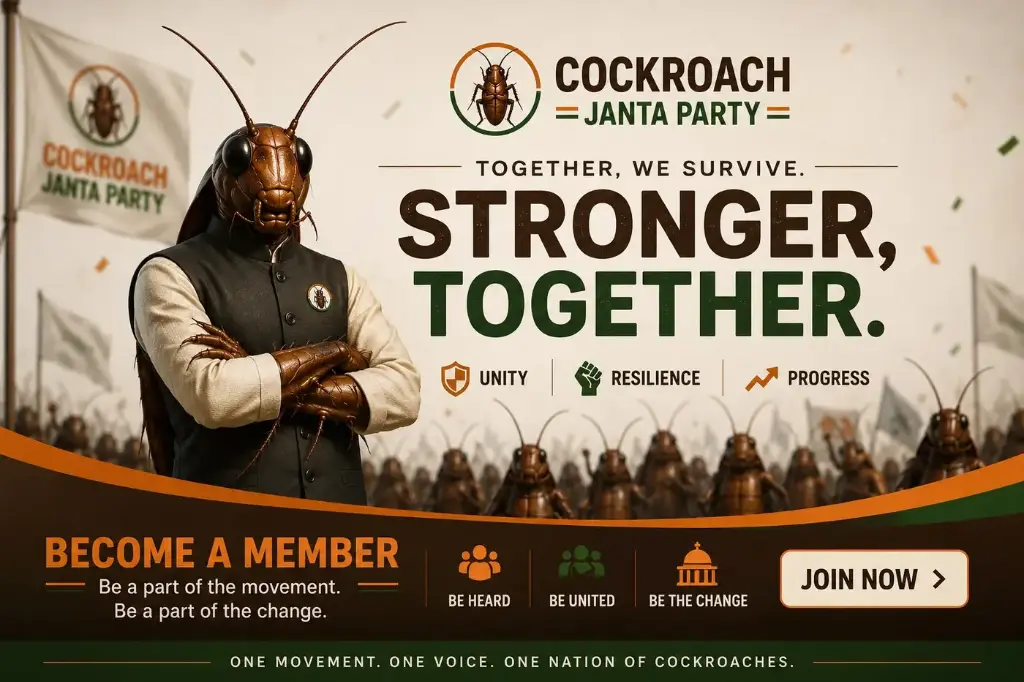
CockroachJantaParty (CJP) memes dominated Indian social media in May 2026. Within days of the CJI Surya Kant cockroach remark, thousands of memes flooded Instagram, X, and WhatsApp. Here is the origin story of CockroachJantaParty memes — the funniest political satire India has ever seen.
The CJP meme phenomenon represents something unprecedented in Indian political culture: a unified, nationwide satirical response that crossed linguistic, regional, and class boundaries within hours. Unlike previous political meme movements that were confined to specific online communities or language groups, CJP memes spread across every major Indian language simultaneously. Hindi, Tamil, Telugu, Bengali, Marathi, Kannada, Malayalam, Gujarati, Punjabi — in each language, regional meme pages adapted the cockroach theme to local contexts, creating a federated network of satire that felt both national and deeply local. This linguistic diversity is a big part of why the movement resonated so widely: every region of India could claim the cockroach as their own.
The cockroach itself was a brilliant meme vehicle. In Indian popular culture, the cockroach is universally understood as resilient, adaptable, and nearly impossible to eliminate. Pesticide companies have spent decades trying to convince Indians that cockroaches are indestructible — the irony of a Supreme Court judge comparing citizens to this famously unkillable insect was not lost on anyone. Meme creators instantly recognized the comedic potential: if the establishment was calling young Indians cockroaches, then young Indians would embrace the identity with pride and humor. The cockroach became a symbol of defiance, yes, but also of resilience — a reminder that no amount of institutional pressure could eliminate the voice of India's youth.
The First CJP Meme
The very first CJP meme was a simple image: the CockroachJantaParty logo with the words "When CJI calls you a cockroach so you start a party." Posted on @cockroachjantaparty Instagram, it received millions of shares within hours. This single meme set the tone for the entire movement — defiant, humorous, and unapologetic.
What most people do not realize is that the first CJP meme was created in under 30 minutes. Within an hour of the CJI's remark going viral, several meme pages had independently created variations of the cockroach-party concept. The @cockroachjantaparty Instagram account was created, the logo was designed using a free online tool, and the first post went live — all within the span of a lunch break. This speed of creation was critical. In the fast-moving world of internet memes, being first to a format often determines which version becomes canonical. @cockroachjantaparty secured this first-mover advantage by posting before any competing accounts could establish themselves.
The logo itself became an instant icon. A simple line-drawing of a cockroach, rendered in the signature saffron and green that would become CJP's visual identity, it was crude enough to be reproducible by anyone but distinctive enough to be instantly recognizable. Within days, the logo was being tattooed, printed on t-shirts, used as profile pictures, and drawn on walls. The CJP logo became the most recognizable political symbol in India, created in a few minutes on a free design website.
The Cockroach Transformation Meme
The most iconic CJP meme format: a side-by-side comparison showing a person before and after joining CockroachJantaParty. Before: sad, unemployed, scrolling through job portals. After: proud cockroach with antennae, thriving, unbothered. This format went viral with thousands of variations — each one a young Indian proudly embracing the cockroach identity.
The transformation meme succeeded because it inverted the expected narrative. In a typical "before and after" format, the transformation is meant to show improvement through some product or service. CJP's version flipped this: the "improvement" was becoming a cockroach — something society considers lowly. This ironic inversion is the heart of CJP's humor. The meme says: "You think calling me a cockroach is an insult? Watch me embrace it." It takes the establishment's weapon and hands it back, sharpened and repurposed.
The format also had an important participatory element. Because the meme was a simple side-by-side template, anyone could create their own version with minimal effort. Users replaced the "before" and "after" images with their own photos or with images that reflected their personal situation — a student before and after exams, an employee before and after a bad boss, a gamer before and after a losing streak. Each variation personalized the cockroach identity, making the movement feel inclusive and infinitely adaptable. This low barrier to participation is what turned a viral post into a lasting movement.
CJI Surya Kant Edits
CJI Surya Kant became the unwilling star of CJP memes. Popular formats included:
- CJI stepping on a cockroach only for it to multiply (reference to the movement's growth)
- CJI in court saying 'cockroach' with increasingly absurd contexts
- CJI Sharma ji ka beta — but the beta is now a proud cockroach
- CJI surprised to see 15 million cockroaches on Instagram
The CJI edits represent a specific subgenre of CJP memes — what internet culture researchers call "adversarial remixing." Unlike the transformation memes which celebrated the cockroach identity, CJI edits were directly critical of the judge and, by extension, the institutional power he represented. These memes ranged from gentle ribbing (CJI looking confused at a screen full of cockroach emojis) to sharper political commentary (CJI in a meeting where every official has cockroach antennae). The variety reflected the diverse motivations of CJP supporters — some were genuinely angry, others were simply enjoying the absurdity of the situation.
One particularly popular sub-format was the "CJI vs cockroach" battle sequence — a multi-panel comic showing CJI attempting various methods to eliminate cockroaches (spray, trap, shoe) with each attempt failing spectacularly. The final panel would show the cockroach not just surviving but multiplying. This format directly commented on the movement's resilience: you can call us names, you can try to suppress us, but we will only grow stronger.
CJP Memes in Hindi
कॉकरोच जनता पार्टी (CockroachJantaParty) के मीम्स ने भारतीय सोशल मीडिया पर तहलका मचा दिया। सबसे वायरल मीम था 'कॉकरोच ट्रांसफॉर्मेशन' — जिसमें एक बेरोजगार युवक CJP जॉइन करने के बाद गर्व से कॉकरोच बन जाता है। CJI सूर्य कांट के एडिट्स भी खूब वायरल हुए। @cockroachjantaparty पर और भी मीम्स देखें।
Regional language meme pages played a crucial role in the CJP meme ecosystem. In Tamil Nadu, the cockroach was paired with local political iconography. In Maharashtra, meme creators replaced the standard cockroach with the local variety, adding Marathi captions that referenced Mumbai's famous pest problems. In West Bengal, the cockroach became involved in adda — the beloved Bengali tradition of long, passionate conversations. Each regional adaptation kept the core CJP message intact while making it relevant to local audiences. This decentralized, community-driven content creation is what allowed CJP memes to penetrate every corner of India's internet.
WhatsApp was another critical distribution channel for CJP memes. Unlike Instagram and X which are public platforms, WhatsApp forwards spread within private family and friend groups — reaching demographics that might never visit Instagram meme pages. Grandparents, aunts, uncles, and family WhatsApp groups became unwitting distributors of CJP content. A meme that started on Instagram would be screenshotted, forwarded to WhatsApp, shared across a dozen family groups, screenshotted again, and eventually uploaded back to Instagram — each cycle introducing the meme to entirely new audiences.
The Impact of CJP Memes
The memes did more than entertain — they mobilised. Each share, each remix, each repost grew the CockroachJantaParty movement. BBC noted that CJP "takes inspiration from the insect — stubborn, reviled and considered indestructible." The memes made politics accessible to Gen Z in a way traditional parties never could. Economic Times called it "a meme-driven, insect-themed movement shaped by hashtags, burnout and ironic despair."
The impact of CJP memes extended beyond social media into real-world political discourse. News anchors debated the memes on prime-time television. Political analysts wrote columns analyzing the cockroach metaphor. Even the Supreme Court was reportedly aware of the memes, with some legal commentators suggesting that the intense public reaction — expressed primarily through memes — had made judges more cautious about dismissive language from the bench. Whether or not this is true, the fact that memes became a topic of serious political analysis is itself a measure of the movement's impact.
Perhaps most importantly, CJP memes created a shared cultural vocabulary for political dissent. Before May 2026, expressing political frustration online often meant writing long threads or engaging in heated arguments. After CJP, a simple cockroach emoji was enough to signal solidarity with millions of like-minded Indians. This reduction of political expression to a universally understood symbol — the 🪳 — is the ultimate achievement of the CJP meme movement. It made political participation as simple as sending an emoji, and in doing so, it made millions of young Indians feel, for the first time, that their voice mattered in the political conversation.
Where to Find CJP Memes
The best CockroachJantaParty memes are on:
- Instagram: @cockroachjantaparty (15M+ followers)
- X (Twitter): #MainBhiCockroach hashtag
- Telegram: t.me/cjp_party
CJP memes prove that satire is not just entertainment — it is political expression. Follow CockroachJantaParty on Instagram for the latest memes, demands, and updates. The cockroach revolution is here, and it is hilarious.